
Experience of angioplasty in lower limbs in peripheral arterial disease in a private clinic in southern Colombia
 Edna Lizeth Castrillon Peña
- Juan Camilo Barrios Torres
- Hernán Isaías Vargas Plazas
Published 2019-05-02
How to Cite
Abstract
Aim: Evaluate the characteristics of patients undergoing angioplasty in the lower limbs, as well as to establish possible associations between the factors leading to complications. Materials and Method: Observational descriptive, cross-sectional and retrospective study conducted during 18 months in which patients with peripheral arterial disease undergoing angioplasty of the lower limb were included, as well their demographic, clinical, and surgical characteristics and the postoperative complications.
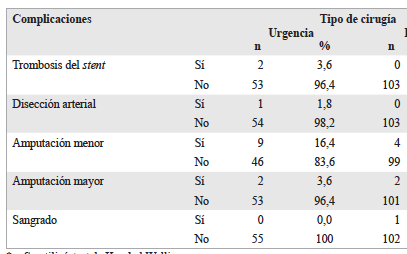
Results: 158 records of patients between 30 and 95 years were evaluated. 65.2% (n = 103) of the procedures were performed not urgently, the most frequently intervened vessels were the superficial femoral artery (64%), the most frequent type of endovascular intervention was the combination of balloon + medicated ball (32.9%), the most used postoperative pharmacological treatment was the combination of acetylsalicylic acid (ASA) and clopidogrel (86.1%). There were 21 cases of complications, the most frequent complication was minor amputation (52%). A higher risk of minor amputation was found when the surgical procedure was performed urgently (p = 0.012, OR [95% CI]: 4.8 [1.4-16.5]).
Discusion: The post-angioplasty complication with statistically significant difference was minor amputation when the procedure was performed urgently, this association was related to the clinical status of the patient at the time of admission and not to the surgical procedure.
Conclusion: Angioplasty performed urgently is as safe as elective procedures, given by the same proportion of bleeding or arterial dissection.